
An Orchestra Forged My Tarnished Soul: The Elden Ring Soundtrack Experience
Elden Ring soundtrack by Budapest Film Orchestra forges symbiotic dread, turning every boss fight into a symphonic pilgrimage.
I still remember the first time the Lands Between truly breathed into my living room. It wasn’t seeing the Erdtree’s golden canopy spread across the sky, nor the first time a Troll’s sword flattened me into the dirt. It was the moment the Budapest Film Orchestra’s strings surged upward like a thermal of molten gold, lifting me out of my chair and shattering any illusion that this was just a game. That sound—a cry from a hundred instruments recorded in a hall somewhere in Hungary—transformed my half-hearted dodge rolls into a tarnished pilgrimage. Even now, in 2026, with countless hours poured into every catacomb and divine tower, the soundtrack remains a ghostly co-pilot, a second skin I never knew I needed.
When Bandai Namco released the official Elden Ring soundtrack back in 2022, they gifted us more than a playlist. They handed over a forge. Each track is a musical anvil, pounding the raw iron of tension into a blade sharp enough to cut through Margit’s delayed overhead slams. I’ve come to think of the Budapest Film Orchestra not as musicians, but as smiths of emotion—their bows are hammers, their brass is bellows, and the resulting alloy is something between awe and pure terror. Watch the behind-the-scenes video of them recording “Erdtree Knights,” and you’ll see it: every violinist leaning into the piece like a warrior bracing for a charge. The conductor’s baton isn’t a wand; it’s a greatsword cleaving silence into melody.
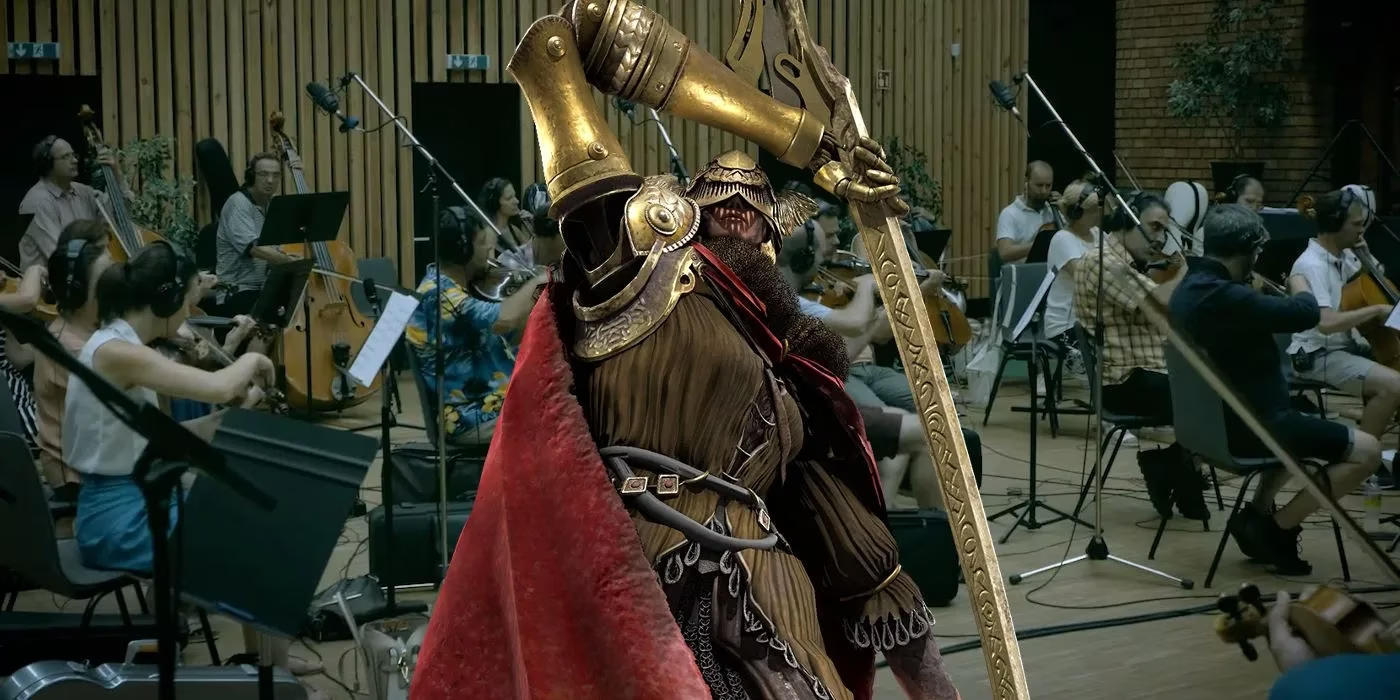
I’ve long believed that a good soundtrack is a rumor whispered in your ear, but a great one is a full suit of armor you wear without realizing it. The Elden Ring score does exactly that. It clads you in a shell of resolve the moment you step into Limgrave’s open fields, the soft choir humming like distant ancestors reassuring a child. Then, without warning, the armor tightens into a vise. When the first notes of a boss theme rumble from my speakers—those trembling cellos that announce Godrick’s grafting obsession—my pulse doesn’t just quicken; it aligns with the tempo, becoming another instrument in the orchestra. I’ve started calling this phenomenon “symbiotic dread,” the rare fusion where my own adrenaline harmonizes with the composition until I’m not sure if the music is reacting to me or I to it.
That fusion reached its strangest peak when I discovered a fellow Tarnished who defeated Margit using a harp controller. Yes, a folk harp. Each string was mapped to an action: one for rolling, one for attacking, another for chugging a crimson flask. The result wasn’t a flawless concert—more like a court musician playing a frantic ballad while dodging a stone dragon’s halberd—but it turned combat into pure improvisation. This brave soul performed a boss fight as if it were a recital, every plucked note a desperate command. Watching the footage, I saw the Elden Ring soundtrack not as a backing track but as a conversation partner. The harp’s erratic melody danced around the orchestra’s intensity, a sparrow weaving through a thunderstorm. It reminded me of playing a pipe organ inside a collapsing cathedral: chaotic, holy, and utterly unforgettable.
I confess I’ve tried to replicate this symbiosis in my own way. In 2025, I ventured into the Land of Shadow with the DLC’s grim choirs hammering at my eardrums, and I realized the Budapest Film Orchestra had become my third lung. Their music doesn’t just accompany the 67 tracks on streaming platforms; it lives there like a sleeping giant you can wake at will. While driving through foggy mornings, I queue up "Erdtree Knights" and the damp road transforms into Liurnia’s misty marshes. During workouts, "Radahn’s Festival" turns push-ups into gravity-defying clashes. Post Malone famously admitted he plays Elden Ring with the music off because the score is too intense for combat—a statement that baffles me as much as it amuses. For me, stripping away the orchestra would be like fighting blindfolded. The music is my eyes.
In these years of exploring FromSoftware’s masterpiece, I’ve come to understand why the soundtrack endures as a standalone artifact. It’s a sonic map of the Lands Between, each crescendo a geographical feature, each leitmotif a demigod’s psychological profile. The Budapest Film Orchestra didn’t just perform notes; they breathed life into regions I’d never physically touch. And when I finally sit back in 2026, controller resting on my knees, and let the game’s ambient tracks wash over me, I feel like an old knight polishing a suit of armor that still hums with forgotten battles. That humming? It’s the orchestra, still working, still forging, still turning my ordinary room into a cathedral of echoes.