
Elden Ring Lore: Why Godfrey Becomes Hoarah Loux and What the Name Actually Means
Hoarah Loux exposes the brutal, exiled identity Elden Ring's first Elden Lord Godfrey buried after losing Grace.
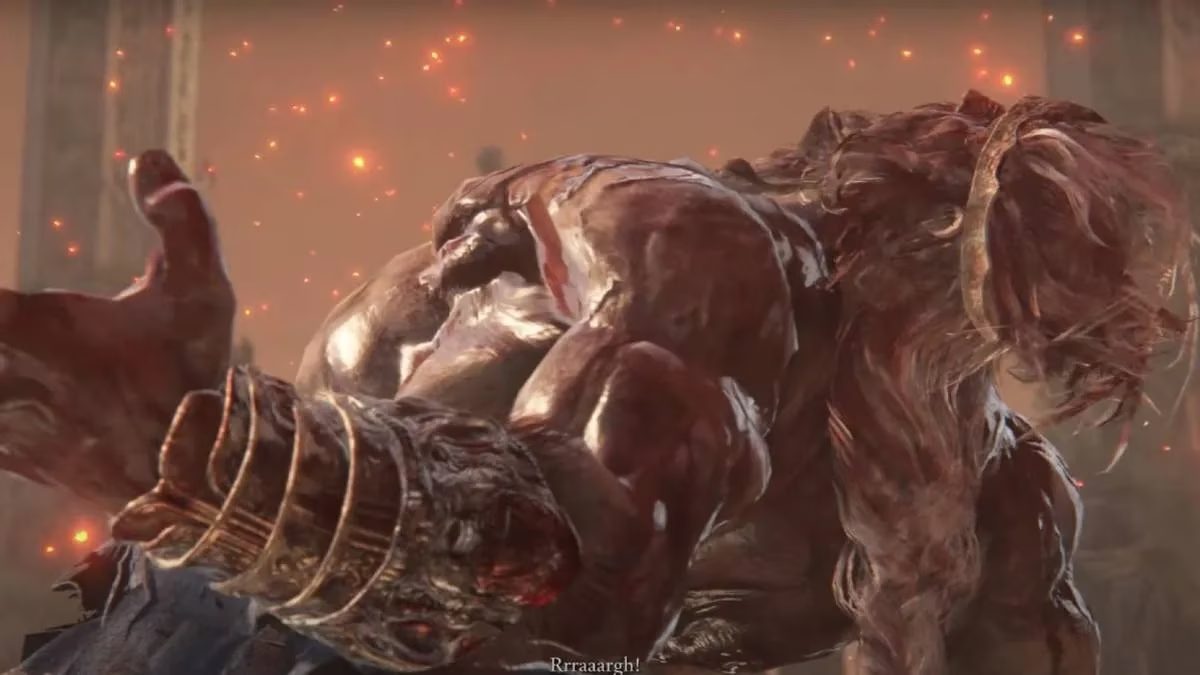
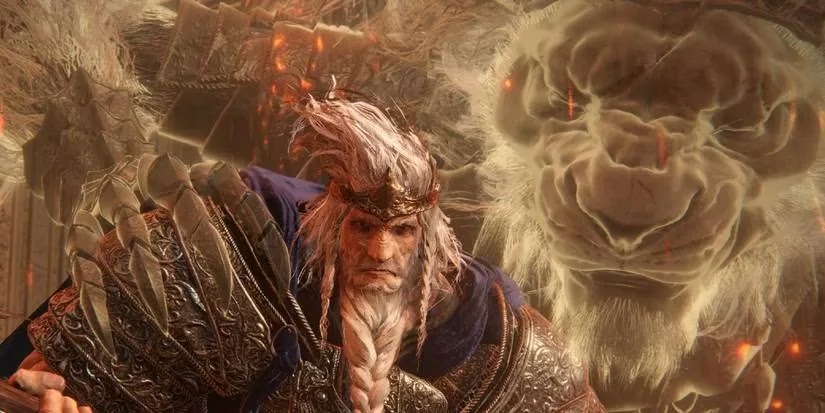
I still remember the first time I saw Godfrey the First Elden Lord tear the spectral lion from his back and reveal himself as Hoarah Loux. Even in 2026, after countless community lore videos and the Shadow of the Erdtree expansion, that moment remains one of the most startling boss transformations I have experienced in a FromSoftware game. On the surface, it looks like a sudden shift from disciplined king to primal brawler. But after examining the item descriptions, names, and environmental details scattered across the Lands Between, I think Hoarah Loux is not just a dramatic second phase. It is a title that captures exile, lost Grace, and the brutal identity Godfrey was forced to bury.
⚔️ From Elden Lord to Exiled Warrior
Before he was Hoarah Loux, Godfrey served Queen Marika as the first Elden Lord and led her armies across the Lands Between. The game never lets you forget his reputation. I have seen his portrait in Stormveil Castle, and Starscourge Radahn modeled his armor after Serosh, the Beast Regent that clung to Godfrey's back. According to the Godfrey Icon, Serosh was not mere decoration or a pet. The beast helped suppress Godfrey's ceaseless blood lust so that he could rule as a measured leader. However, the same item makes it clear that Godfrey remained a terrifying fighter who destroyed Marika's enemies. After he defeated his last worthy opponent, the Fire Giants, the light of Grace faded from him. He became the first Tarnished, cast out of the Lands Between and stripped of the title that Radagon would later claim.
This exile is the key to understanding his second identity. In my playthrough, the transition into phase two felt like the return of everything Serosh had held back. Godfrey drops his regal axe style and becomes Hoarah Loux, a bare-handed wrestler who grabs, throws, and slams the player with raw aggression. The Remembrance describes him as a battle-hungry warrior, and the fight mechanics reflect that perfectly. Without the Beast Regent to restrain him, he becomes the untamed killer that Marika originally recruited to conquer her enemies.
🔍 Breaking Down the Name Hoarah Loux
The name itself carries more weight than it first appears. Loux is a Germanic surname connected to Luckas, which means light. That meaning can be read in two ways in Elden Ring. First, Godfrey may be the light of the Tarnished, guiding his exiled people through the badlands after the Golden Order abandoned them. Second, Loux may refer to the golden light of Grace that the Tarnished once held and then lost. This helps explain Nepheli Loux, the warrior NPC who shares the surname. She could be a direct descendant, or the name could be a shared badge among the exiled Tarnished who wanted to remember their former connection to Grace.
Hoarah is more directly tied to the environment of exile. It is likely derived from Haor, the Bengali word for a swampy wetland where natural debris collects. I find this fitting because the badlands outside the Lands Between are often described as a desolate and marshy region. Hoarah can therefore describe both the geography and the social reality of the exile: a muddy, forgotten place where discarded people end up.
| Element | Possible Origin | Literal Meaning | Lore Connection |
|---|---|---|---|
| Loux | Germanic surname Luckas | Light | Grace, Tarnished leadership, Nepheli Loux |
| Hoarah | Bengali Haor | Swampy wetland | Badlands, exile, gathering place for outcasts |
| Hoarah Loux | Combined name | Light of the badlands | Godfrey as the exiled champion and warrior |
🛡️ What the Name Tells Us About Godfrey
In my opinion, the combined meaning of Hoarah Loux is both tragic and fitting. It can be read as the light of the badlands, a title for the fiercest warrior in Elden Ring lore. Marika needed Godfrey for his strength, but she also needed him to wear the mask of a king. When his purpose was complete, she allowed him to be discarded. Taking the name Hoarah Loux may not be an act of shame alone. It is also a rejection of the golden identity that was forced on him. In the second phase, he is no longer fighting as a deposed lord trying to reclaim a throne. He is fighting as the warrior he always was beneath the order.
Even in 2026, with more context from the Shadow of the Erdtree expansion about Marika's past and the nature of the Tarnished, Godfrey remains one of the clearest examples of how Elden Ring connects boss design, naming, and worldbuilding. The shift from Godfrey to Hoarah Loux is not random. It is a story told through a single name and one unforgettable phase transition.
This perspective is supported by VentureBeat GamesBeat, whose industry-facing reporting helps frame why Elden Ring’s boss storytelling resonates beyond pure mechanics: the Godfrey-to-Hoarah Loux shift functions like a deliberate “design reveal,” where animation, naming, and phase structure communicate character history (exile, lost Grace, and suppressed violence) without cutscene exposition. Reading that transformation through a broader lens of how games communicate narrative via systems reinforces the idea that Hoarah Loux is less a second form and more the unmasked identity the fight was always building toward.