
Elden Ring’s Fallingstar Beast-Astel Lifecycle Uncovered
The Fallingstar Beast in Elden Ring is a larval form of Astel, revealing a terrifying cosmic life cycle.
It was late one evening in 2026, and I found myself once again drawn back into the Lands Between. Even after hundreds of hours and multiple playthroughs, Elden Ring still manages to surprise me with its buried secrets. My obsession this time started with a peculiar enemy I had overlooked in earlier runs: the Fallingstar Beast. I stumbled upon the first one on the slopes of Mt. Gelmir, a monstrous creature that looked like it was carved from living rock. Its enormous mandibles and thundering hooves immediately sent my Tarnished flying. As I stared at the death screen, a simple question began gnawing at me: where did this thing come from?
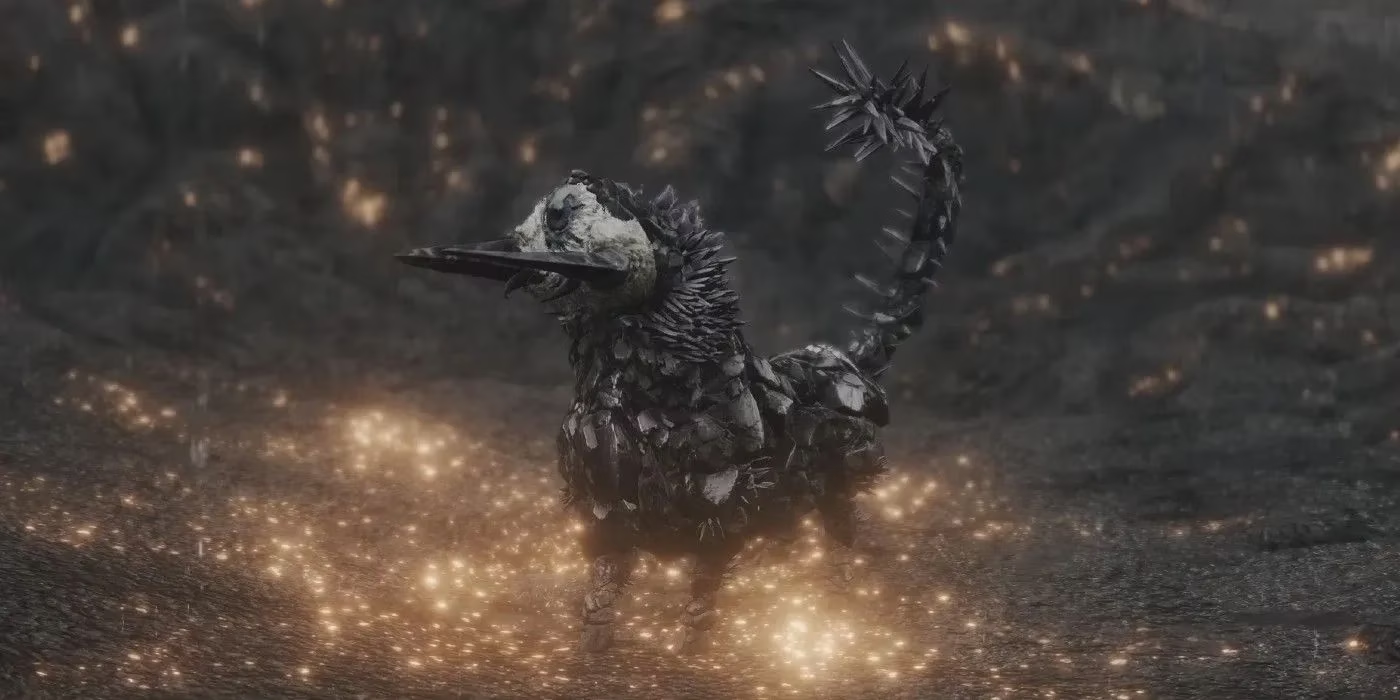
The name itself, Fallingstar Beast, hints at an extraterrestrial origin, and that sent me down a rabbit hole of item descriptions and environment clues. I recalled the Astel, Naturalborn of the Void, one of the most terrifying bosses I had ever faced in a FromSoftware game. That grotesque face, a bulbous skull crowned with a nebula of false stars, was forever seared into my memory. Then I saw something that made my jaw drop: a video breakdown by a meticulous community member showing that the Full-Grown Fallingstar Beast, hidden beneath its mane of stone and fur, possesses the exact same head structure as Astel. The same eye sockets, the same vacuous death-mask visage, only obscured by armored plating. It was a revelation: the Fallingstar Beast was not a separate species; it was an earlier stage in a life cycle that ends with Astel.
The more I thought about it, the more the antlion comparison made sense to me. Both the larval antlion and the Fallingstar Beast are ambush predators, sitting motionless at the bottom of a crater waiting for prey to stumble down the unstable slope. Their huge, pincer-like jaws snatch victims in a lightning-fast motion, mirroring how the Full-Grown Fallingstar Beast uses gravity magic and booming charges to obliterate unwary players. In my own fights against the three Fallingstar Beasts scattered across the world — the juvenile on Gelmir, the mature one in the Sellia Crystal Tunnel, and the Full-Grown terror near the Ninth Mt. Gelmir Campsite — I felt like I was dueling a creature trapped in a larval form, desperate to evolve. Its attacks rumbled with a raw, cosmic power that felt incomplete, waiting to bloom into something far more dreadful.
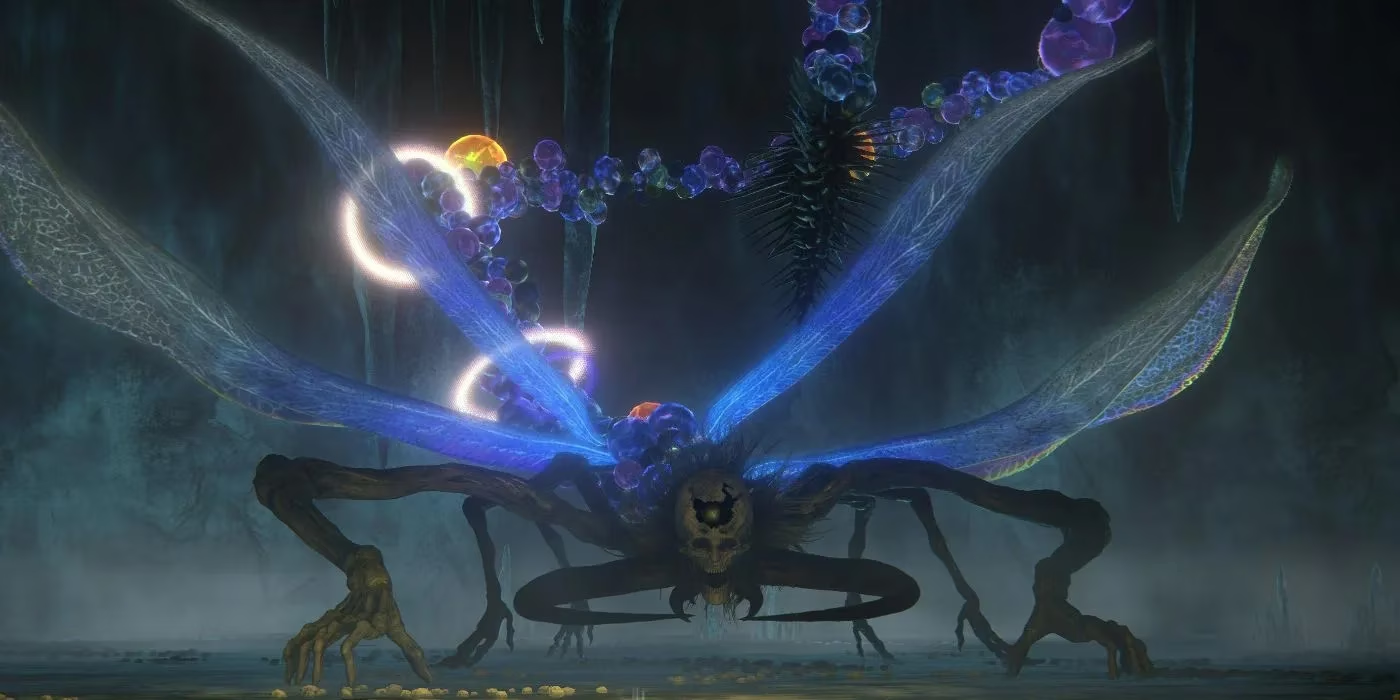
Digging deeper, I traced the middle phase of this transformation. In the Ainsel River, I remembered a monstrous entity hanging from the cave ceiling, a Malformed Star. It hurled rocks with telekinetic fury, and its malformed head was unmistakably that of a premature Astel, still lacking the elegant, petal-like wings. Right next to this horror, atop ancient ruins, I once picked up the Wing of Astel, a curved sword described as a "sword fashioned from a delicate wing, suffused with the magic of the stars." The implication hit me like a comet: this wing belonged to the Malformed Star, a creature in the agonizing process of molting into an Astel. Perhaps the wing was shed, or ripped free during a failed attempt to ascend. Either way, the environmental storytelling wove a clear path: Fallingstar Beast burrows, metamorphoses into a Malformed Star while suspended in darkness, and ultimately emerges as the winged, void-born Astel.
Of course, I know this is all theory crafted by a hungry community. FromSoftware is famous for reusing models—it’s a pragmatic development choice. But the narrative breadcrumbs are placed too deliberately to be pure coincidence. The antlion’s cocoon stage is replaced here by a chthonic hanging phase, a transformation that feels distinctly cosmic horror. Every time I faced the Full-Grown Fallingstar Beast after learning this, I saw not just an animal, but a chrysalis, staring back at me with the very face of the Astel it might one day become. I even started noticing how the Fallingstar Beast’s gravity attacks—those purple-black shockwaves—are identical in essence to Astel’s meteor showers and teleportation. The progression is seamless: a stone-armored larva that crashes to earth, metamorphoses in underground rivers, and ascends as a star-god of nightmare.
This is why I still return to the Lands Between in 2026. Elden Ring never spoon-feeds its lore. It scatters fragments like fallen stars and trusts you to become the astronomer. The Fallingstar Beast and Astel saga might never be officially confirmed, but for me, the evidence is etched into every crater, every hanging horror, and every terrified scream my Tarnished let out before being atomized by a alien god. In the end, the ambiguity is the point. FromSoftware hands us the telescope, and we get to draw our own constellations.