
How I Froze Time in Elden Ring After 1,000 Hours
One Tarnished's devotion pushed Elden Ring's in-game clock to its breaking point—999:59:59 after 1,000+ hours.
I still remember the moment the clock broke. Not a physical snap—no grinding of gears nor puff of smoke—but a digital surrender, a flatline at 999:59:59. After yet another moonlit duel against a wandering Bell Bearing Hunter, I glanced at the save file and felt the world tilt. The clock had become a gilded cage for time, rejecting any more seconds as if it were an overflowing chalice already brimming with starlight. Over a thousand hours in the Lands Between, and the game simply refused to count any further. My name is Jay, and this is how I became a Tarnished trapped outside the boundaries of measured devotion.
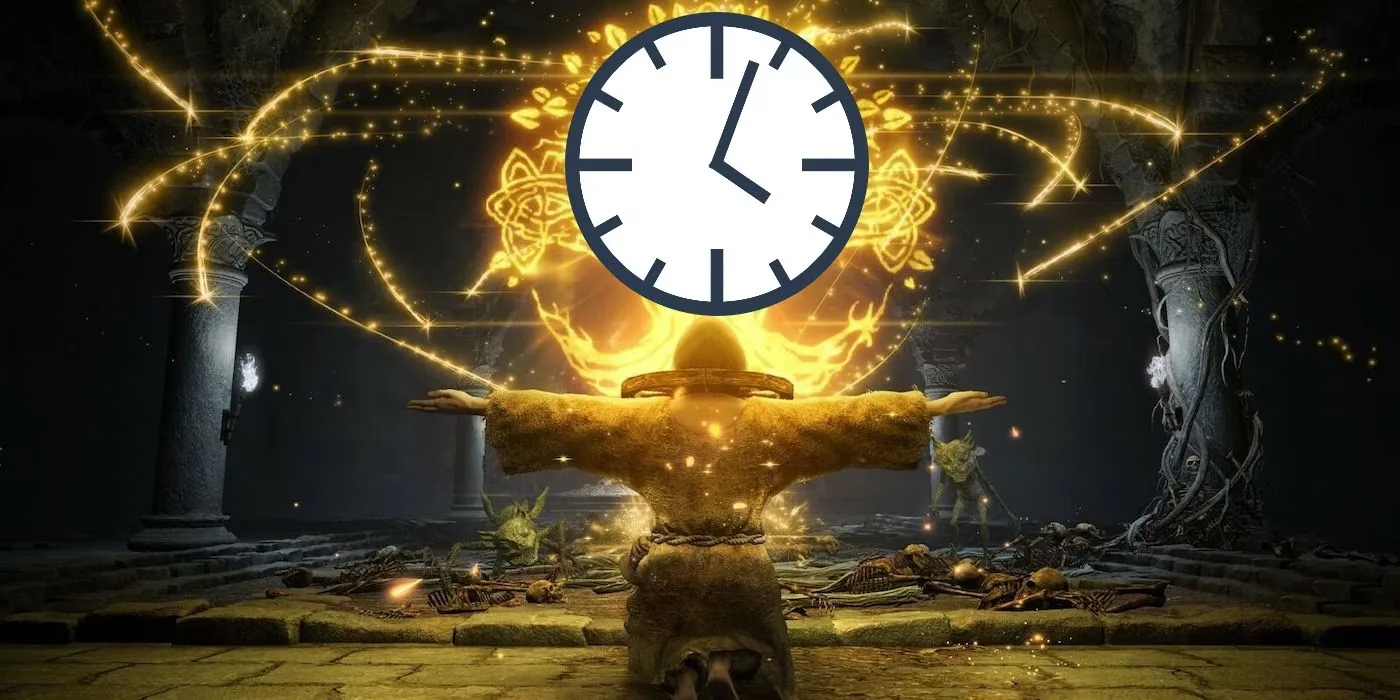
A Clock That Forgot How to Tick
The journey started in February 2022, when Elden Ring burst into our lives like a comet of melancholic grandeur. Back then, I was just another soul looking for an escape from the monotony of office life—procurement spreadsheets and fluorescent-lit meetings. The game’s open world promised something different: no quest arrows cluttering the screen, no hand-holding, just a colossal map that unfolded like a Möbius scroll where every path looped back to curiosity. I would wake up, brew a pot of strong tea, and let the Lands Between swallow me whole for hours at a stretch. On good days I clocked ten hours; on weekends, the only punctuation was the sunrise coiling through my blinds.
The first few hundred hours were a fever dream of discovery. I remember finding the deeproot basin entirely by accident, its roots dangling like petrified lightning. I remember the first time I parried a Crucible Knight with nothing but a buckler and a prayer, my heart hammering like a piston. The game became my second language, its rhythms a lullaby in the chaos of everyday life. Days off from work turned into mini-sabbaticals where I barely moved from my chair, sustained by coffee and the relentless pull of “what’s around that next cliff?”
The Unraveling of Time
Other players chased speedruns or bizarre controller challenges—someone even conquered the Elden Beast with a piano, each note a roll of the dice. My obsession was quieter: a slow, thorough erosion of every secret the game held. The clock ticked past 500 hours, then 800, and I started to notice a strange phenomenon. The counter felt less like a measurement and more like a living wind-up toy, its key twisting tighter with each session. My playtime was like a river that had carved a canyon through the bedrock of daily life, unstoppable until it hit the dam of those three digits.
When the counter locked, I felt a disorientation similar to staring at a stopped clock in a dream. There they were: 999 hours, 59 minutes, and 59 seconds—a ceiling made of code. Some fellow Redditors did the math (shoutout to the r/EldenRing community) and figured out I’d been averaging around 7.5 hours every single day since launch. A few accused me of leaving the game running overnight, an idle Tarnished gathering digital dust, but that wasn’t my style. I earned those hours the old-fashioned way: by dying to Malenia 200 times, by cataloging every armor piece in the Roundtable Hold, by hosting fight clubs at the Academy Gate where invaders streamed in like moths to a furious bonfire.
The Lands Between, Unmarked and Unforgiving
What makes 1,000 hours feasible isn’t just obsession—it’s the design itself. Elden Ring treats your attention like a compass, not a checklist. Without map markers, the world feels less like a game and more like a worn atlas with pages whispering in different languages. Every ruin, every spectral-candle grove, every NPC that coughs up a cryptic line becomes a personal find. I compared this once to decoding a living grimoire: you can’t just skim the index; you have to feel each page turn beneath your fingers. That philosophy let me sink into the world until the borders between “me” and “my character” blurred, until the Tarnished’s journey felt as real as my commute.
And the difficulty? It’s a forge, not a gatekeeper. After a while, dying stopped being failure and became a teacher wearing a crown of thorns. Every boss was a puzzle box. I remember fighting Radagon and the Elden Beast so many times that their attack patterns became a lullaby—a deadly one, sure, but still a rhythm I could sway to. When the clock froze, I was in the middle of a Level 1 playthrough, just to feel that original terror again. The number stopped; the journey kept moving like a serpent chewing its own tail.
Life Beyond the Numbers
Three years have passed since that clock froze—an eternity in the gaming sphere, where new releases cascade constantly. It’s 2026, and I still fire up my save file sometimes, just to walk the sun-drenched fields of Limgrave under the Erd-tree’s glow. The clock still reads 999:59:59, a monument to all the mornings stolen from sleep and all the evenings spent dodging invisible assassins in the Ordina Evergaol. I’ve since found a better balance: I rock climb, I cook elaborate meals, I actually reply to texts within the same century. But that singular stretch of my life, where a video game became a house I lived in, left a permanent mark on me.
What does it mean to love something so much that you break its ability to measure that love? To me, it’s like trying to pour the ocean into a teacup and then laughing when the cup overflows. The laughter, the exhaustion, the camaraderie on Reddit threads—it was all real, even if the counter couldn’t track it. So, if you ever spot a phantom in Limgrave, standing motionless while the in-game sun climbs into noon, wave hello. It might be me, still exploring, still counting hours that no machine can hold. And if you check my profile, the clock will still be frozen—a relic of the year I gave the Lands Between everything I had, and received a frozen number as my crown.