
How to Stop and Enter Walking Mausoleums in Elden Ring
Elden Ring Walking Mausoleums let you duplicate Remembrances; stop them by attacking foot weak points or using Spirit Jumps.
In Elden Ring, the Lands Between are packed with strange sights, but few are as memorable as the Walking Mausoleums. These colossal, tortoise-like creatures trudge across the map with enormous bells hanging beneath their bodies, and they can be spotted long before a player reaches them. A newcomer might assume they are just background decoration or a roaming hazard. That assumption would be a mistake. Each Walking Mausoleum is actually a mobile duplication chamber, and bringing one down is one of the most satisfying side activities in FromSoftware’s open-world epic.
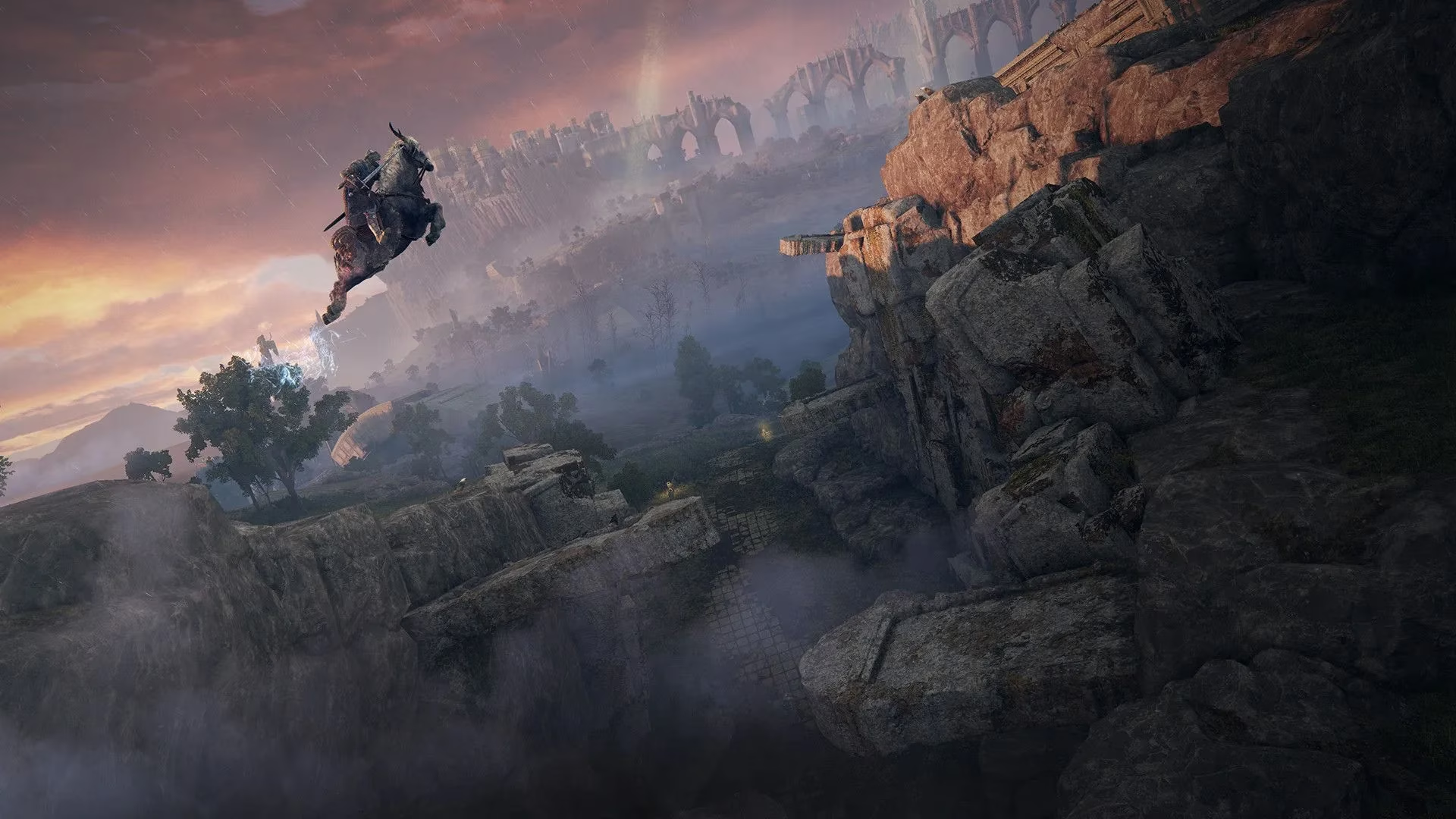
So, what exactly are these creatures? Walking Mausoleums are massive stone-and-flesh beasts that act like wandering temples. Once stopped and entered, they let a player duplicate the rewards obtained from slaying demi-god bosses, known in game as Remembrances. This is incredibly useful because a single Remembrance can normally be exchanged for only one boss weapon, spell, or item. Duplicating it allows a player to claim another reward from the same fallen demigod without starting a New Game Plus run.
How to stop a Walking Mausoleum
Stopping one of these giants might look intimidating, but the process is much simpler than it appears. The key is to avoid getting stomped and to focus on the weak points located on the creature’s feet.
A player should approach on Torrent, the spectral steed, and ride close to one of the Mausoleum’s feet. The back feet are usually the safest choice. Each foot is covered with white, barnacle-like chunks that look a bit like clusters of stone coral. Those are the weak points, and attacking them is all it takes to bring the entire structure down.
The Walking Mausoleum moves quite slowly, so there is no need to rush. A player can carefully hit one or two of those white clusters, ride away if the creature shifts its weight, and then return for another pass. In most cases, they do not even need to clear every single chunk. By the time one or two chunks on the third foot are broken, the Mausoleum should collapse with a thunderous crash. After that, the entrance can be found on the front side of the creature, and going inside opens up the duplication menu.
What if the weak points are missing?
Not every Walking Mausoleum plays by the same rules. Some of them do not have the usual barnacle-like weak points on their feet. A player who starts hacking at the legs of one of these special Mausoleums might spend minutes dealing zero meaningful damage. Does that mean the Mausoleum cannot be entered? Not at all—it just requires a different approach.
One such Mausoleum roams the northeast part of the swamp in the Liurnia of the Lakes region. Instead of attacking its feet, a player should look for a Spirit Jump nearby. Using that jump with Torrent allows them to leap directly onto the Walking Mausoleum itself. It is a clever twist that rewards observation. When the usual weak points are absent, the environment usually offers a way up.
Tips for a smooth approach
-
Players should always use Torrent. The horse gives the mobility needed to dodge the slow but heavy stomps.
-
Target the back feet first. They tend to be easier to reach without getting trapped under the creature’s body.
-
Players should not stand still between attacks. Even a slow stomp can flatten an overconfident player.
-
If no white chunks appear on the legs, players should scan the area for a Spirit Jump instead of wasting flasks or weapon durability.
-
Keep an eye on the bell. The bell signals that a Mausoleum is available for duplication, and stopping it is the only way to claim that benefit.
Comparison of Mausoleum types
| Type | Weak points | Method |
|---|---|---|
| Standard Walking Mausoleum | White barnacle-like chunks on feet | Attack the chunks until it collapses |
| No-visible-weak-point Mausoleum | None on legs | Use nearby Spirit Jump to board it |
Why bother with a Walking Mausoleum?
A player might wonder whether the effort is worth it. The answer is yes, especially for anyone who wants to experiment with multiple boss rewards. Remembrances are tied to some of the most spectacular weapons and spells in Elden Ring. Duplicating the right one can open up an entirely different build without another full playthrough. Given how long Elden Ring is, that convenience is a huge time saver.
There is also something wonderfully strange about the whole process. A giant walking temple with a bell, covered in barnacles, roaming a swamp or a field, is exactly the kind of weird, unforgettable image FromSoftware does so well. Even in 2026, long after the game’s launch and its major expansion, these creatures remain one of the most talked-about environmental puzzles in the Lands Between.
Ultimately, stopping a Walking Mausoleum is not about raw power. It is about observation, patience, and knowing when to change tactics. Whether a player is chipping away at barnacle clusters or launching off a Spirit Jump, the reward is the same: another chance to claim a piece of a demigod’s legacy.
According to coverage from GamesRadar+, tackling Elden Ring’s Walking Mausoleums is less about brute force and more about reading the encounter: circle on Torrent to avoid the slow, crushing stomps, chip away at the pale barnacle-like growths on the legs to force a collapse, and if a mausoleum lacks those weak points, treat it like an environmental puzzle by scouting for a nearby Spirit Jump to board it. Once grounded, the real payoff is practical—access to Remembrance duplication—letting players claim multiple boss rewards from a single demigod without waiting for New Game Plus.