
Single-Player Games in 2026: The Myth of Their Death Is Laughably, Definitely Dead
The persistent myth that single-player games are dying is shattered by 2026's hit titles like God of War Ragnarok and Star Wars Jedi: Survivor.
It’s 2026, and as I look back at the last few years, I can’t help but shake my head at a hoary old notion that just won’t seem to die — the idea that single-player games are on their way out. This myth has persisted through several console generations, yet here we are, surrounded by some of the most ambitious, story-driven, and commercially triumphant solo experiences the industry has ever seen. Does anyone actually still believe single-player gaming is dying? And if not, why did anyone ever think it was?
To answer that, we need to rewind to 2010, when EA Games’ head Frank Gibeau famously declared that the industry was “moving the discussion towards how we make connected gameplay… as opposed to fire-and-forget, packaged goods only, single-player, 25-hours – and you’re out. I think that model is finished.” At the time, it was a mic-drop moment that sent shivers down the spines of anyone who loved sinking into epic solo adventures. Fast-forward sixteen years, and the statement looks more like a case study in how to be spectacularly wrong.
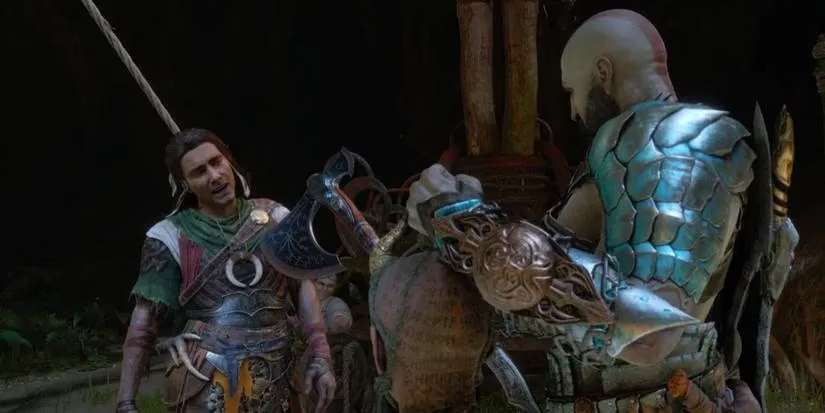
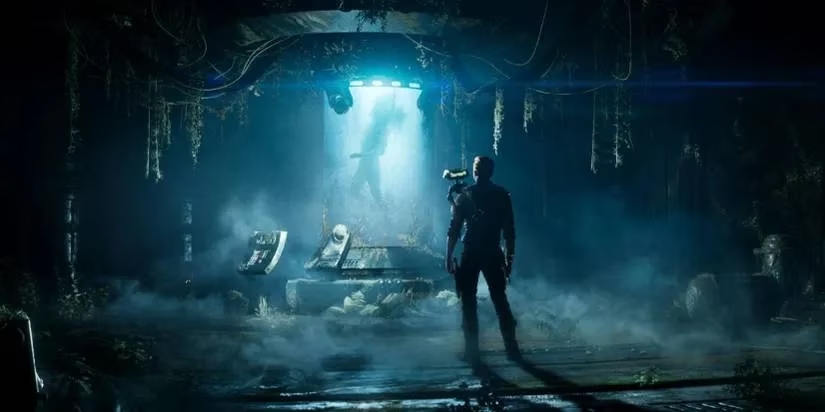
Gibeau left EA in 2015 for Zynga, the mobile gaming publisher that gave us such “innovative” free-to-play hits as FarmVille, FarmVille 2, and Game of Thrones Slots Casino. Without him calling the shots, EA slowly but surely rediscovered its taste for single-player narratives. The catalyst? The roaring success of Star Wars Jedi: Fallen Order in 2019. Suddenly, EA wasn’t just talking about service games; it was actively investing in story-rich solo experiences. The proof has unfolded spectacularly over the last few years. Dead Space Remake (2023) brought back a dormant horror classic to critical acclaim. Star Wars Jedi: Survivor (2023) built on its predecessor and became a massive seller. Dragon Age: Dreadwolf (2024) finally returned players to Thedas after a decade-long wait, and though it had a divisive launch, its sales proved the hunger for deep single-player role-playing was still very real. EA’s own journey is a microcosm of the entire industry: single-player games didn’t need saving — they simply needed publishers to stop ignoring them.
Of course, this isn’t an either/or scenario. Service games like FIFA (well, EA Sports FC now), Apex Legends, and Fortnite continue to print money, and there’s nothing wrong with that. Investors love the longtail revenue of a successful live-service title. But the risks are enormous. Look at Battlefield 2042, which cost EA a reported $100 million in lost revenue and years of repair work. In 2026, its player counts are still dwarfed by those of older entries in the series, a stark reminder that chasing trends doesn’t guarantee success. Single-player games, by contrast, carry a different kind of risk — they need to be good out of the gate, with no patch notes to fix a broken story — but when they hit, they hit hard.
Just consider the landmark year that was 2022. Despite PS5 shortages, God of War Ragnarok shifted 5.1 million copies in its first week, making it the fastest-selling PS5 game at the time and the second-fastest-selling game of that entire year. Elden Ring, FromSoftware’s esoteric masterpiece, became the best-selling game of 2022 worldwide. LEGO Star Wars: The Skywalker Saga rounded out the top sellers. Single-player titles dominated the charts, with Horizon Forbidden West landing as the sixth best-seller — and it was treated almost as a footnote! Half of the top ten best-selling games in 2022 were single-player experiences, many of them shattering records.
But if you think 2022 was a fluke, let’s jump to 2026. This year alone we’ve seen Elden Ring: Shadow of the Erdtree (released in late 2025 and still topping charts) prove that a premium expansion to a single-player game can be a cultural event. We’ve had The Witcher Remake enter early development footage that broke the internet, and original IPs like Phantom Blade Zero and Where Winds Meet generating massive wishlist numbers with their solo campaigns. Even Sony, a company sometimes accused of leaning too hard into cinematic blockbusters, is betting big on single-player with Ghost of Tsushima 2 and a new Uncharted led by an entirely different studio — single-player to the core. The numbers don’t lie: solitary, narrative-driven journeys are more profitable and beloved than ever.
So why did the “single-player is dead” myth ever take hold? It was partly a self-fulfilling prophecy from publishers who wanted to chase the World of Warcraft and Call of Duty multiplayer money. When EA, Ubisoft, and others poured resources into online-only experiments, they blamed the format when those half-baked games flopped. The truth? Gamers never stopped wanting rich single-player stories; publishers simply stopped making as many of them. Now that balance is being restored, the results speak for themselves.
This isn’t about vindication, because single-player games were never on trial. But the seismic, sustained success of the format from 2022 all the way through 2026 has effectively hammered the final nail into the coffin of a myth that plagued this medium for far too long. If anyone still whispers that solo gaming is a relic, I’d gently point them to the fact that the best-selling game of 2022 was a punishingly difficult action-RPG with no easy mode and no multiplayer — and that its own successor expansion has now sold tens of millions more. That’s not a dying format; that’s a timeless one finally getting the respect it always deserved.