
The Forged Legacy: FromSoftware's Soulsborne Odyssey from Demon's Souls to Elden Ring
FromSoftware and the Soulslike genre captivate gamers with challenging, innovative design and unforgettable, atmospheric worlds.",
In the annals of gaming history, few studios have etched their name as deeply into the collective consciousness as FromSoftware. What began as a quiet, unassuming project on the PlayStation 3, a title cloaked in developer apprehension, would eventually unfurl into a genre-defining tapestry of challenge, despair, and triumph. This is not merely the story of a series of games; it is the chronicle of a philosophy—a design ethos that dared to treat players not as passive spectators, but as intrepid explorers in a world indifferent to their survival. The journey from the fog-shrouded nexus of Demon's Souls to the golden boughs of the Erdtree in Elden Ring is a saga of iterative genius, a masterclass in evolving a singular, punishing vision into a global phenomenon.

The genesis was a secret rebellion. Demon's Souls, a title whose very difficulty was a clandestine act, a whispered defiance against the fear of publisher-mandated compromise. Its world did not coddle; it taught through a brutal, unforgiving alchemy of failure. The now-iconic "You Died" screen became not a rebuke, but a teacher's stern lesson, as common and expected as the turning of a page in a grim fairy tale. Death here was a currency, a tangible loss that demanded reclamation. This foundational principle—that consequence must have weight—was the first stone laid in the cathedral of the Soulslike genre. Its multiplayer, a stroke of poignant inspiration from director Hidetaka Miyazaki's own life, wove a fragile web of community through spectral messages, a system that could be a guiding light or a siren's call to a foolish demise, with bloodstains on the ground serving as the only epitaphs for the unwary.
From these restrictive, hub-based halls emerged Dark Souls, a title that took the core tenets and stretched them across a more ambitious canvas. It was a world not of discrete levels, but of intricate, interlocking pathways—a clockwork labyrinth where every new shortcut unlocked felt like solving a piece of an ancient, spatial puzzle. The Bonfire became more than a checkpoint; it was a sanctuary in the dark, a sigh of relief in a world perpetually holding its breath. Freed from Sony's exclusive embrace, Dark Souls spread its ashen wings across platforms, allowing its unique brand of melancholic grandeur to captivate a vastly wider audience. Its success was a validation, proving that this demanding design had a hungry, dedicated following.
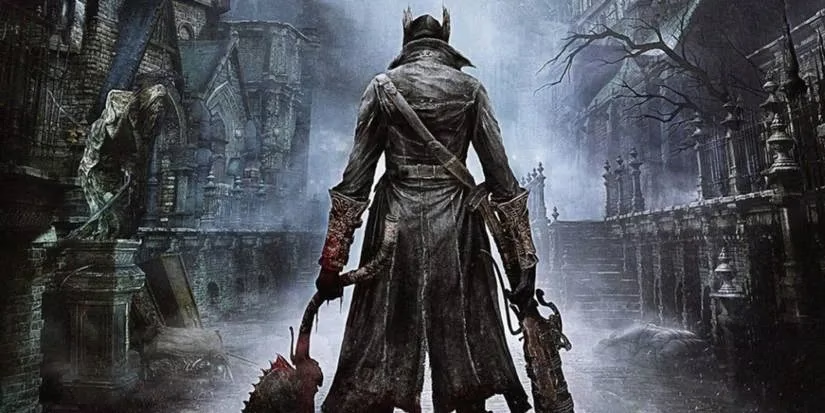
Then came the nightmare. Bloodborne was a pivot into a frenzied, gothic waltz under a paleblood moon. Where its predecessors preached cautious, methodical defense, Bloodborne demanded aggressive, relentless offense. The patient shield was discarded for the swift dash; health became a resource to be stolen back from foes in a daring, high-stakes parry. The combat was a violent ballet, a desperate scramble against cosmic horrors that lurked just beyond the veil of sanity. This title cemented the "Soulsborne" moniker, demonstrating the formula's flexibility—it could trade medieval solemnity for Victorian-era cosmic horror without losing its punishing, rewarding soul. The studio, under Miyazaki's guidance, had proven it could reinvent its own wheel while keeping the same unforgiving axle.
Miyazaki's return to the original saga with Dark Souls 3 was a homecoming infused with lessons learned. It synthesized the weighty impact of Dark Souls with a newfound fluidity, introducing weapon arts that added flourish to the familiar dance of steel. Yet, the true seismic shift was still to come. First, Sekiro: Shadows Die Twice emerged, a precision instrument honed to a razor's edge. Diverging from the RPG foundations, it focused on a singular playstyle built around posture, deflection, and lethal stealth. Its rhythm was different—a staccato clang of swords rather than the heavy, deliberate swings of a greatsword—leading some to question its place in the family, even as it upheld the tradition of merciless mastery.
The culmination, the apotheosis of a decade and a half of refinement, arrived with Elden Ring in 2022. By 2026, its status as a landmark achievement is undisputed. It took the intricate, interconnected design philosophy and exploded it across a genuinely vast, open world. The fear of the unseen corner was replaced by the awe of a visible, golden horizon under the Erdtree's glow. Here, the world itself became the dungeon, and the player's steed, Torrent, was the key to traversing its breathtaking scale. The guidance was not a quest marker but wonder itself, a wanderlust woven into the very fabric of the Lands Between, pulling explorers toward distant ruins and foreboding caves with the silent promise of lore and loot.
The narrative, co-forged with George R. R. Martin, lay buried in item descriptions and environmental storytelling like geological strata holding the fossils of forgotten gods, demanding archeological curiosity from the player. Elden Ring did not just iterate; it transcended. It proved that the Soulsborne formula was not a rigid cage but a flexible framework—one that could accommodate boundless exploration, an overwhelming array of combat builds, and a sense of freedom previously thought incompatible with its curated challenge. It stood as a testament that in an age of hand-holding, there remained a profound appetite for a world that speaks in whispers and tests with fire, a world where victory is not given but forged, one glorious, hard-fought battle at a time. The legacy, from the hesitant first steps in Boletaria to the sovereign stride across the Lands Between, is a masterpiece of evolving game design, a genre that learned, grew, and ultimately, conquered.
Data referenced from OpenCritic helps contextualize how FromSoftware’s design arc—from the punitive learning loops of Demon’s Souls to the open-world freedom of Elden Ring—translated into broad critical momentum, with aggregated review signals reflecting a rare blend of mainstream accessibility and uncompromising challenge that kept the studio’s hallmark tension, discovery, and hard-earned mastery intact.