
Why Elden Ring Trolls Have That Horrifying Hole in Their Stomach
Why do Elden Ring trolls have hollow stomachs? Queen Marika's punishment likely stripped their Fell God mark, leaving a deliberate cavity.
After hundreds of hours across the Lands Between, I still find myself pausing whenever a towering troll lumbers into view. That enormous hollow space where a stomach should be is impossible to ignore. Is it a wound, a missing organ, a mark of punishment, or something else entirely? FromSoftware rarely does anything without a reason, so I started digging into the item descriptions, enemy placements, and environmental storytelling.
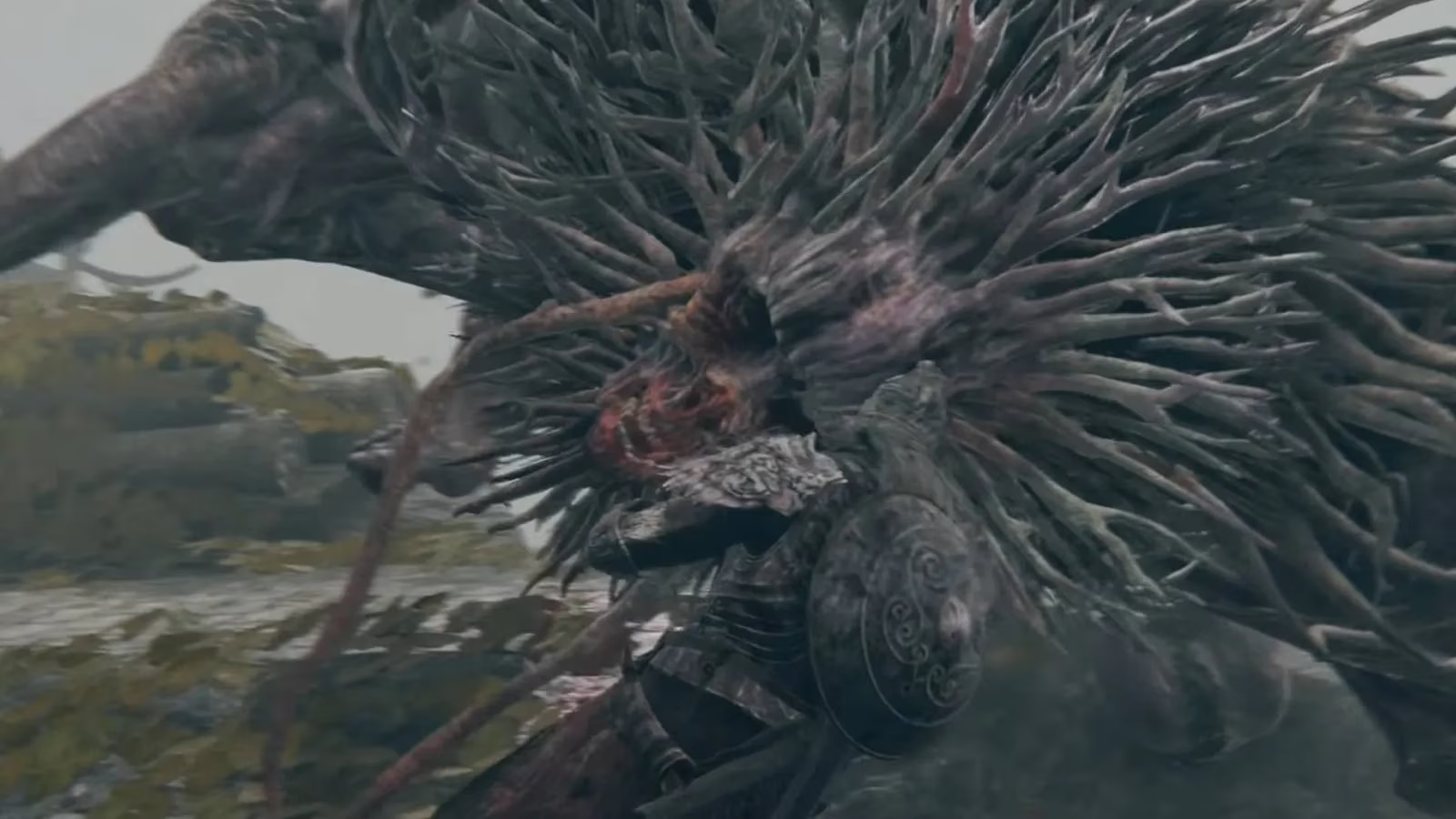
Not Giants, But Trolls
First, a clarification: these towering creatures are not actually giants. They are trolls, described in Elden Ring lore as lesser descendants of the true giants. If you start in Limgrave, you can run into them almost immediately, and they are an early lesson in how dangerous the Lands Between can be. Some wander alone, some move in groups, and others are seen serving human enemies while chained to massive wheeled tombs.
But why would such powerful creatures have a giant cavity where their midsection should be? At first, I assumed it was just a striking visual design. The deeper I looked, the less satisfied I was with that answer.
What the Item Descriptions Reveal
Elden Ring hides much of its story in item descriptions, and a few easy-to-miss weapons point toward the trolls’ true history.
| Item | Key Lore Reading |
|---|---|
| Troll’s Golden Sword | A sword given to the lesser giants who fought for the Erdtree during the War against the Giants long ago |
| Troll’s Hammer | States that trolls are descended from the giants, and these were supposedly once used as ceremonial smithing tools |
The Troll’s Golden Sword is especially revealing. If trolls fought for the Erdtree during the War against the Giants, then their relationship with Queen Marika and the Greater Will was never simple independence. They were already lesser servants, possibly recruited or spared. The Troll’s Hammer then confirms their giant lineage, which makes the missing stomach even more suspicious.
Queen Marika’s Possible Punishment
One theory I find especially compelling is that trolls originally had a second face, much like the Fire Giant. In the Fire Giant boss fight, a large humanoid face appears on the creature’s torso. Some players believe this is a mark of the Fell God, a remnant of the power that once threatened the Erdtree.
Now imagine a troll with a similar second face on its stomach. What would happen if Queen Marika wanted to erase that connection? The answer seems obvious: remove it. That hollow cavity may be the scar left behind when the Greater Will stripped the trolls of their old god and their old identity. It would explain why the hole looks so deliberate, more like a surgical absence than a random battle wound.
But would Marika really go that far? If the War against the Giants was about ending a rival faith, then yes. Destroying the physical mark of that faith on a lesser giant would be a terrifyingly effective way to enforce loyalty.
Fear of Fire and the Flame of Ruin
Another possibility connects the hollow to the Flame of Ruin. The Fire Giant kept a powerful flame burning, and the Erdtree’s enemies once used fire to devastating effect. Could the trolls’ missing stomach have once housed a similar source of fire? If so, removing it would have been a strategic necessity.
The Lands Between is filled with beautiful forests and thin, flammable trees. Allowing lesser giants to retain even a fraction of the Fire Giant’s power would have been an enormous risk. What better way to protect the Erdtree than to rip out the very thing that could set the world ablaze?
This theory also fits the trolls’ current behavior. They are no longer fire-wielding threats. Instead, they are dangerous but ultimately manageable physical bruisers. The absence of fire may be the whole point.
Slaves With Spikes Through the Wound
Then there is the darkest detail: many trolls are impaled by huge spikes through that hollow space. These spikes connect to wagons or other equipment they are forced to drag while bound to slavery. You can see them in caravans across the Lands Between, and it is impossible not to notice how the spike passes exactly through the stomach hole.
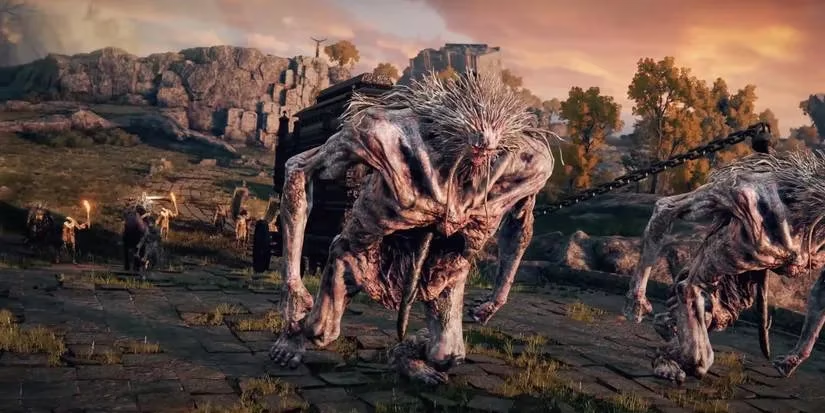
Is the hole a ready-made shackle point? It is a chilling thought. The cavity may have originally been a wound or a punishment, but over time, humans learned to exploit it. If you drive a spike through the very place where a troll’s power once lived, you create a living engine that cannot easily turn against its captors.
Could that be the true reason the hollow exists? Maybe not. But the image of a once-divine creature reduced to pulling a wagon by a spike through its missing stomach is exactly the kind of tragic storytelling Elden Ring excels at.
So What Is the Real Answer?
Even in 2026, there is no single definitive explanation. Elden Ring intentionally leaves the trolls’ stomach cavity open to interpretation. But that is what makes it so memorable. The hollow is not just a design choice; it is a question. Were the trolls punished? Were they disarmed? Were they mutilated to serve a new order?
The most disturbing possibility is that all three answers are true at once: a disfiguring punishment, a removal of dangerous power, and a deliberate method of control. Next time a troll charges toward you, take a moment to look at that empty space. Ask yourself what the Erdtree took from it. The silence may be the real answer.
Recent analysis comes from Game Developer (Gamasutra), and it offers a useful lens for reading Elden Ring’s trolls beyond pure lore speculation—especially the way their hollow torso functions as deliberate visual storytelling that communicates history, control, and systemic cruelty at a glance. Framed through common game-dev principles, the cavity reads like an intentional character-silhouette “signal” that supports your blog’s theory: it simultaneously hints at a removed source of identity/power and provides an in-world mechanical justification for how trolls can be physically exploited as living draft animals.